
By James Carter
Dubai's Business Bay has become one of the city's most dynamic districts, a dense cluster of glass towers, luxury residences, hotels and restaurants that sits just south of Downtown Dubai along the Dubai Water Canal. For residents and visitors in the UAE who are searching for companionship services in this area, the first thing to understand is that the legal baseline is firm: under UAE federal law, prostitution and commercial sex are prohibited across all emirates, including Dubai, Abu Dhabi and Sharjah. Anyone looking at a Dubai escort listing is therefore operating inside a legal grey zone at best, and the practical question becomes how to reduce personal, financial and legal risk rather than how to find a loophole.
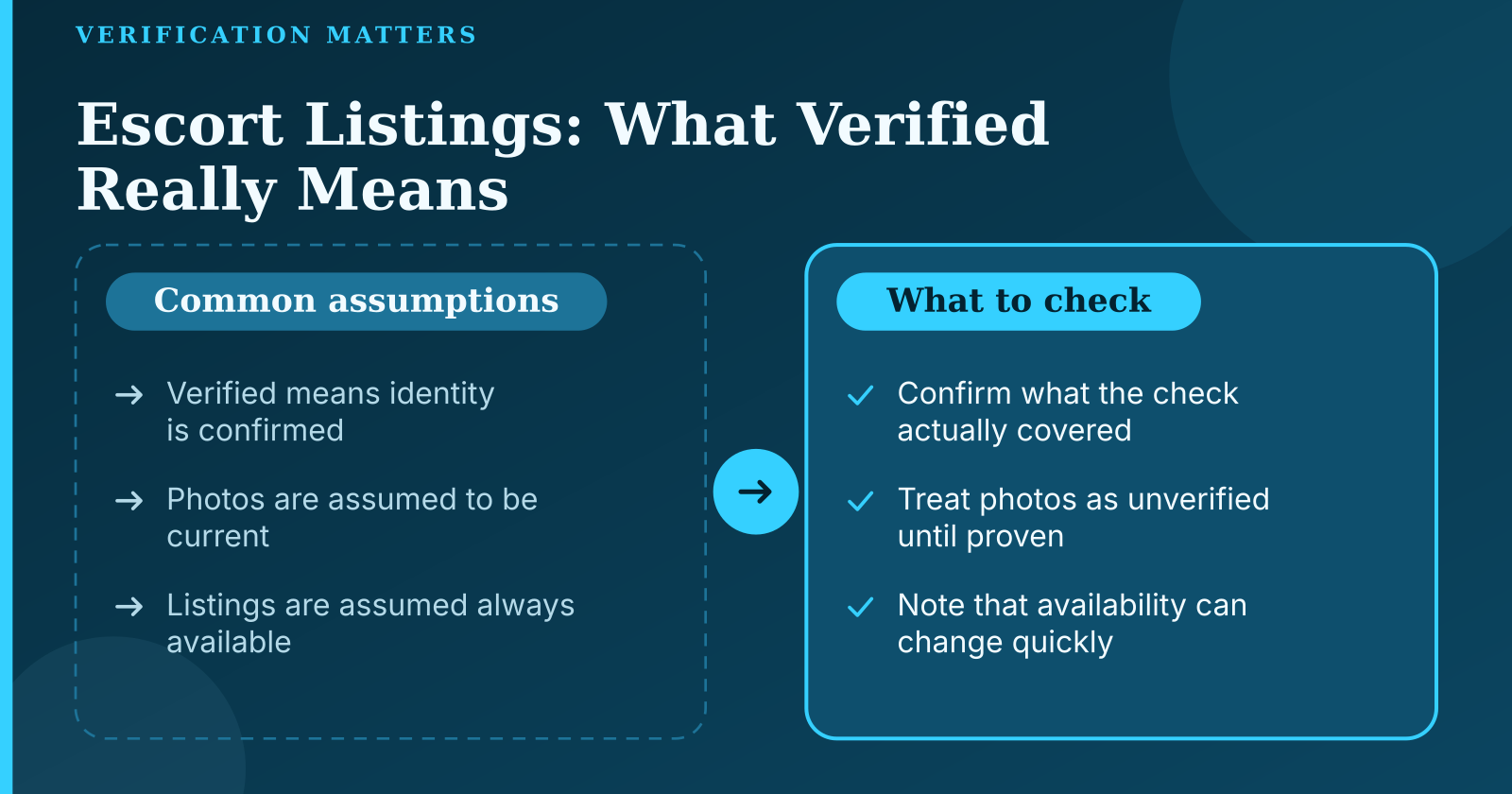
That is where the concept of verification matters. Many people assume that a "verified" label guarantees the profile is authentic, the person is who the photos show, and the listing is current. In practice, verification is a set of limited checks, and its meaning depends entirely on what the platform actually did. A platform might confirm that a photo is not a stock image, or that a phone number was once active, or simply that someone clicked a button. None of these things is the same as confirming identity, age or availability in a meaningful way. The aim of this long-read is to help you understand those differences before you rely on any listing, including those on business bay escorts pages, so that your expectations match what can realistically be verified.
Federal Decree-Law provisions in the UAE criminalise prostitution and the facilitation of it, and the penal code also addresses public indecency and the conduct of persons in private spaces. Enforcement is shared between federal bodies and local police forces, and in practice the Dubai Police, Abu Dhabi Police and Sharjah Police each operate with their own priorities and reporting channels. Dubai, as the most visible commercial hub, sees a lot of attention on hotels, short-term rentals and online advertising, which is why many listings are short-lived and why platforms operating in the emirate tend to be cautious about content.
For a client, the legal exposure is not theoretical. Hotel check-in records, bank transfers, phone records and messaging logs all create a trail, and those trails can be examined after the fact. Cash payments leave less of a digital footprint but also offer no protection if something goes wrong, and they can complicate any dispute because there is no record of what was agreed. A sensible reader treats every interaction as potentially documented, because in the UAE that assumption is closer to reality than most people expect. The safest default is to avoid any engagement that depends on concealing communications or payments, since concealment itself often becomes the evidence in a later investigation.
Platforms that list or promote services in or towards the UAE also operate under a regulatory cloud. Content moderation, takedown requests and cooperation with authorities are all part of the environment. This matters for the user because a platform that moderates aggressively may remove listings without notice, and a platform that does not moderate at all may be less reliable on the things that do matter to you, such as data handling and dispute responses. When you assess any site, ask how it handles reports, how it responds to removal requests, and whether it publishes a clear policy on prohibited content. Vague answers usually signal that the operator has not thought through its obligations.
Verification is usually described in three tiers, and each tier answers a different question. Photo verification asks whether the images are original and recent, typically by comparing them against each other or against a live photo taken on request. Identity document checks ask whether the person behind a profile holds a valid government-issued identity, and this is the strongest form of verification but also the one most often claimed without being performed. Manual review means a human at the platform has looked at the profile and approved it against a checklist. Live-check procedures involve a real-time confirmation, such as a short video or a request to pose in a specific way, and they are useful against recycled imagery but do not establish identity on their own.
The limits of each method matter as much as the methods themselves. Photo checks cannot confirm age or consent. Document checks depend on the platform having access to a reliable verification process and on the person not using someone else's documents. Manual review is only as good as the reviewer's time and training, and it can be overwhelmed when volumes rise. A badge that says "verified" without a description of which of these checks was done is closer to a marketing statement than to a guarantee. A good habit is to ask what the badge covers and when the check was last performed, rather than treating the word itself as sufficient.
Updated availability is the other half of the promise, and it deserves the same scrutiny. A listing that shows "available now" is only meaningful if it carries a timestamp, because availability changes by the hour and a status that is three days old may be wrong. Look for a visible last-updated date, and be sceptical of listings where every profile claims to have been refreshed at the same moment, since that can indicate an automated process rather than a genuine check. Freshness is one of the easiest things to fake and one of the most useful things to verify, so it is worth treating as a signal in its own right.
A badge without a method is a claim, and a timestamp without a date is decoration. The useful question is always: what was checked, by whom, and when?
When you compare options, a practical set of criteria will serve you better than general impressions. Start with profile completeness: a listing that gives a consistent description, a clear set of recent images, stated languages and a defined service window is generally more trustworthy than one that offers only a few blurred photos and vague claims. Next look at response transparency. Does the platform explain how contact works, how quickly messages are answered, and what happens if a booking is cancelled? A platform that hides these details is asking you to take risks that it has not disclosed.
Cancellation and dispute policy is one of the most important factors and one of the most overlooked. Before any money changes hands, you should know whether a deposit is refundable, who holds it, how a disagreement is escalated, and whether the platform will intervene at all. Payment method clarity runs alongside this: a platform that accepts only unrecorded transfers, or that routes payment through unfamiliar third parties, gives you little recourse if things go wrong. Privacy protections are the last major criterion. Check whether the site collects more personal data than it needs, whether it shares that data with third parties, and whether it allows you to delete your account and records.
Different types of listing services carry different risk profiles. Independent directories tend to be cheap to run and easy to join, which means they vary widely in quality and often have the weakest verification. Agency-style platforms usually have more structure, including standard terms and a point of contact, but they also take a cut and may be less transparent about who actually provides the service. Direct-contact listings, where you reach a person through a phone number or messaging app, offer the least intermediation and therefore the least recourse. Each model trades cost against trust and dispute options, and you should decide which trade-off you are comfortable with before you start browsing.
Local practice in Dubai also shapes what is typical. Rate bands are generally quoted in AED and tend to vary by time window, with late-night and weekend bookings priced higher than weekday daytime arrangements. Seasonality matters too: the winter tourist period from roughly November to March brings more visitors to Business Bay's hotels and serviced apartments, and major events such as trade fairs and sporting fixtures can create short spikes in demand. Unusually low prices for a premium area, or pricing that changes sharply without explanation, are a warning sign rather than a bargain. Treat any quote as a starting point to verify, not as a fixed fact.