By James Carter
Teen Patti is one of those card games that looks simple from the outside and reveals its depth only after a few hundred hands. Three cards, a handful of betting decisions, and a table full of people who each believe they can read the others. That combination makes it a magnet for two very different kinds of behavior: skilled bluffing, which is the heart of the game, and cheating, which quietly destroys it. Anyone who plays Teen Patti regularly, whether on a phone app or at a home table, eventually runs into the question of where the line sits. This guide, prepared with players of all levels in mind, works through that boundary carefully, explains how suspicious play actually looks, and lays out practical steps for protecting yourself. If you want a broader background on the game's mechanics and tricks that circulate online, you can start with teenpatti.tips, but the real value lies in understanding why certain behaviors cross the line and what to do when you notice them.
Cheating in Teen Patti is often misunderstood because the word gets applied to anything that feels unfair. A player who makes a large bet with a weak hand and wins the pot is not cheating. A player who folds after a tense exchange and then reveals a monster hand is not cheating either, even if it feels like a betrayal. Strategy in an imperfect-information game depends on concealment, and concealment means you will sometimes be deceived. What separates bluffing from cheating is not whether a player was deceived, but how the deception was produced. Bluffing uses legal actions that every player is allowed to take. Cheating obtains information or control that the rules do not grant to that player. Keeping this distinction clear is the foundation for everything else in this guide.
Bluffing in Teen Patti is the act of representing a hand stronger than the one you hold, and it works because betting is itself a form of communication. When you raise, you are telling the table something about your confidence, your bankroll, and your read on the people still in the pot. A well-timed raise with a weak hand asks opponents to pay a price they may not want to pay. The mechanics are entirely visible to everyone at the table. Every player can see the same chips move, the same timing, the same folds. Nothing about this process requires privileged knowledge, and that is precisely why it is allowed.
Good bluffing depends on consistency and context. Experienced players think about who is still in the hand, how they have behaved earlier in the session, whether they tend to call too often or fold too quickly, and how their betting size fits the story they are telling. A bet that is too small may look like a probe or a weak hand, while an oversized bet can read as desperation. Position matters as well, because acting late gives you more information about what others have done. All of these tools operate on observable behavior. You are not reading a hidden card; you are reading a pattern that anyone attentive could also read.
Bluffing also has a limit that is easy to overlook. A bluff becomes a problem when it stops being a decision and starts being a mechanism. If you know exactly which opponent will fold to any raise because you are receiving information you should not have, you are no longer bluffing. You are exploiting an unfair advantage, and that is where the moral and rule-based line is crossed. Legitimate deception hides your intentions from players who must make decisions with the same information you have. Cheating hides the game state itself.
Cheating in Teen Patti falls into a few broad categories, and the common thread is that each one gives someone access to information or actions the rules do not permit. The most obvious category involves card manipulation: marked cards at a physical table, a dealer who arranges the deck, or software that reveals the next card to one participant. Any method that lets a player know what others hold, or what cards are coming, is cheating regardless of how it is delivered. Collusion is the second category. When two or more players coordinate their play, share hand information, or deliberately chip each other up while working against the rest of the table, they undermine the basic premise that every seat competes independently.
The third category is technical, and it deserves particular attention because it is the form most often advertised online. Bots and scripts automate decisions, sometimes with response times no human could match. Unofficial tools claim to predict outcomes, expose hidden cards, or give an edge by manipulating the client. A related risk involves account takeover, where someone gains access to a legitimate account and uses it to play, to move funds, or to collude with a partner. Some players also try to exploit bugs in the client software, and while the intent to exploit a glitch is still a rule violation, the line between a genuine bug and deliberate abuse is often clarified by how the player behaved after discovering it.
Between clear cheating and clear bluffing sits a band of gray areas, and platforms classify these differently. Multi-accounting, where one person controls more than one seat, is typically prohibited because it allows information sharing and guaranteed collusion. Soft collusion is subtler: players who repeatedly swap seats to sit near a friend, or who avoid confrontation with a partner while aggressively targeting strangers, may not be exchanging cards, but the pattern still distorts the game. Account sharing has a similar effect because it blurs who is actually making decisions. When in doubt, the useful question is whether the behavior depends on a relationship or a hidden channel that other players cannot access.
A simple test separates the two: if the advantage would disappear the moment every player could see the same information, it is a strategy. If it only exists because someone sees what they should not, it is cheating.
Collusion tends to leave traces in the way chips and hands move between a small group of players. Chip dumping, where one player deliberately loses chips to a partner, is one of the clearest signals. A player who plays unusually loose and bleeds money into a single opponent, then disappears when that opponent is short-stacked, deserves attention. Signaling is harder to prove but common in live games, where a glance, a gesture, or a particular way of checking can communicate strength or weakness. In online play, the equivalent is out-of-game communication, such as messaging a partner while playing the same table.
Technical cheating often reveals itself through timing and consistency. Human players vary their response times, sometimes thinking for a long time over a close decision and acting instantly when the decision is obvious. Automated play tends to be too uniform, responding in fractions of a second regardless of the complexity of the spot, and it rarely displays the small hesitations and mood shifts that mark a real person. Players who suddenly improve dramatically without any change in study or session length may also be using outside assistance, though improvement alone is not evidence and should be weighed with other indicators.
In physical games, the patterns are different but equally concrete. Marked cards may show consistent irregularities on the backs. A dealer who shuffles in a way that keeps certain cards together, or who handles the deck in an unusual rhythm, may be arranging outcomes. Peeking, where a player glimpses cards they should not see, can happen at home games where players sit close together and the deck is not well managed. In unregulated venues, the risk is higher because there may be no independent oversight, no rotation of dealers, and no standard procedure for handling disputes.
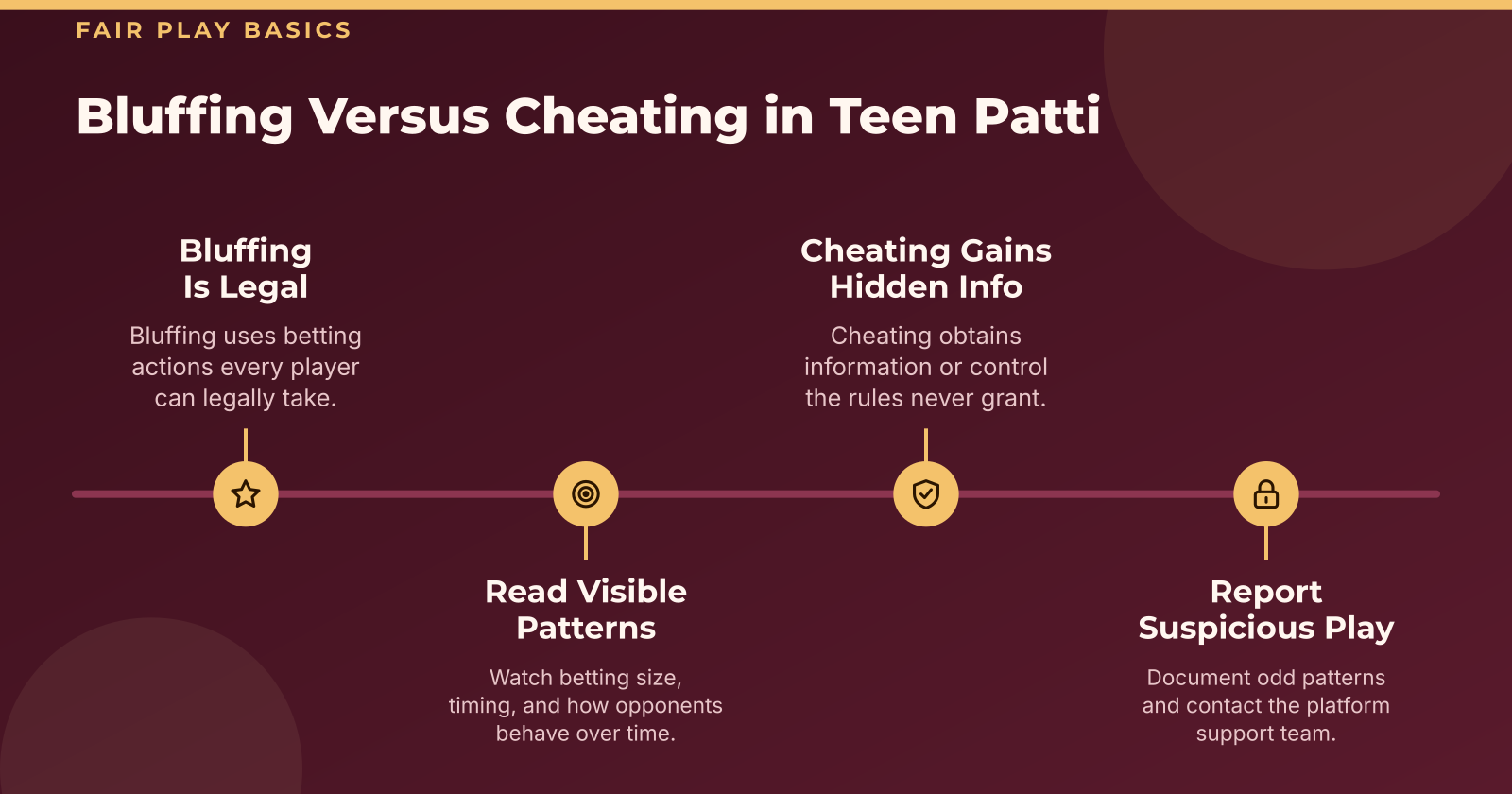
Suspicion is easy to feel and hard to confirm, and the biggest mistake players make is treating a run of bad luck or an unusual hand as proof of wrongdoing. Poker-family games have enormous variance. A player can lose a dozen big pots in a row to hands that were correct to play, and a player can win several improbable hands without cheating at all. The useful approach is to look for patterns that persist over a meaningful sample rather than reacting to isolated events. A few hands tell you almost nothing; a few hundred hands with the same suspicious behavior start to tell a story.